

The Nordic Research and Education Networks (NREN’s), National Metrology Institutes (NMI’s), and NORDUnet have launched a pilot to investigate technology that can fundamentally change how fibre optic networks are used to distribute time with very high accuracy.
The importance of knowing time
Knowing time with high accuracy is essential for a wide range of activities, from comparing astronomical observations made from different locations to air traffic control and to interconnecting telecommunications networks.
Most countries have national agencies (known as National Metrology Institutes) tasked with offering a high-precision time sources, usually atomic clocks. Traditionally, the time from such clocks has been distributed by radio, and more recently by satellite services such as GPS. Unfortunately, radio and satellite are susceptible to interruption, jamming and spoofing.
Time distribution using optical networks would be more reliable, offering NMI’s a secure way to distribute high-precision time signals.
“The NRENs are uniquely positioned to lead the introduction of innovative technologies such as high-accuracy terrestrial time distribution. We already operate large fibre optics networks, and have extensive experience in working across borders, synchronizing operations to different standards and geographical challenges,” says Raimena Veisllari from the Norwegian NREN Sikt, technical lead of the new Nordic time and frequency pilot.
A white rabbit has changed the game
Distributing time with high precision on long-haul networks has become possible due to recent technological developments. In 2008, physicists at the CERN research centre needed extreme accuracy timing for their experiments. This led to the development of a protocol named White Rabbit (see textbox) which enables sub-nanosecond accuracy. Several devices supporting the technology have since become commercially available.
In recent years, the White Rabbit technology has been adapted for use on long-haul networks, allowing distribution of accurate time signals over long distances such as between the Nordic countries. Together with the NMI’s of Denmark, Norway, Sweden, and Finland, NORDUnet and the Nordic NRENs have agreed to trial White Rabbit for cross-border time distribution, to understand opportunities and limitations of the technology, and to investigate the provision of a network-based time service.
Offering a time distribution service based on White Rabbit is of high interest to NRENs. The need for sub-nanosecond accuracy is not confined to experimental physics; astronomers and atmospheric scientists now demand the same level of precision. The cross-Nordic EISCAT atmospheric facility illustrates this need perfectly. Since the facility’s antennas are geographically distributed, ultra-high-accuracy timestamping is essential for synthesizing the data and conducting detailed analysis.
Safer than satellite-based time data
For NMI’s, a network-based service would allow the distribution of high-precision time to other sectors such as utilities, telecoms, transport, and more. If GPS can no longer be trusted, establishing another mechanism distributing time is a societal challenge. In times of geopolitical tensions, the need for protecting critical societal sectors against malicious attacks has become evident. Besides fibre networks this is true for the electric grid and other utility services, hospitals etc. Many control systems rely on satellite-based time data signals, which have become increasingly vulnerable to jamming or spoofing attacks.
According to a 2023 report from the UK Space Agency and the UK Department for Science, Innovation and Technology, a 24-hour outage of GPS systems will cost the United Kingdom some 1.4 billion £.
“This situation creates momentum for an effort to build an alternative time distribution service through terrestrial networks. Since the technology we are looking to introduce will not depend on satellite- or radio-based time data, a large amount of uncertainty and vulnerability is avoided,” notes Raimena Veisllari
Not a normal network service
Internet data is sent over networks using a technology called packet switching. This technology is reliable and allows data to be re-sent or redirected if there are interruptions. However, to achieve these benefits, packet switching assumes that exact time of each packet is not very important. To overcome this limitation, White Rabbit does not use the packet switching infrastructure of the internet.
For a network provider such as NORDUnet, this means that White Rabbit is a non-data service, i.e., a network service that use the optical fibre network in a different way than the regular internet traffic. The challenge for the provider is to allow White Rabbit and internet services to co-exist on the same network. For NORDUnet, a key purpose of the Nordic White Rabbit pilot is to learn if this co-existence is technically feasible and if it can be done in a cost-effective way.
No two fibres are alike
Furthermore, to achieve the highest precision, the White Rabbit network-based paradigm is based on bi-directional fibres. For traditional internet traffic, data is sent on a pair of fibres, one for each direction. While one fibre carries data from A to B, its twin handles data in the opposite direction. For the purpose of internet traffic, the two can be assumed to have the same properties.
However, this assumption does not hold for very high precision time signal. In reality, two fibres within a cable cannot be manufactured to be exactly alike, so subtle differences in length will exist. Also, repair work during the lifespan of the cable will inevitably introduce further inaccuracies.
To illustrate, a difference in the length of two fibres running from Copenhagen to Stockholm by just one metre will correspond to a difference of 5 nanoseconds for a signal travelling between the two cities. For internet traffic, 5 nanoseconds do not matter, but for a sub-nanosecond accuracy time service it makes all the difference. Furthermore, repairs to optical fibre cables can change the length of fibres in ways operators typically will not be made aware of.
To overcome this challenge, fibre optical networks must be adapted to allow transmission of time signals in both directions on a single fibre, eliminating the uncertainty. And this must be done in a way that can co-exist with ordinary internet traffic to leverage existing NREN fibre infrastructure.
Pilot project throughout 2026
The Nordic time and frequency pilot will run throughout 2026. Besides the Nordic NRENs and NORDUnet, the project involves the National Metrology Institutions of the Nordic countries.
“In collaboration with the metrology institutes, we aim to produce several use cases that will allow us to demonstrate the feasibility and effectiveness network-based time services, and hopefully in time secure the financial backing for the evolution of a permanent, high-precision time distribution infrastructure,” says Raimena Veisllari
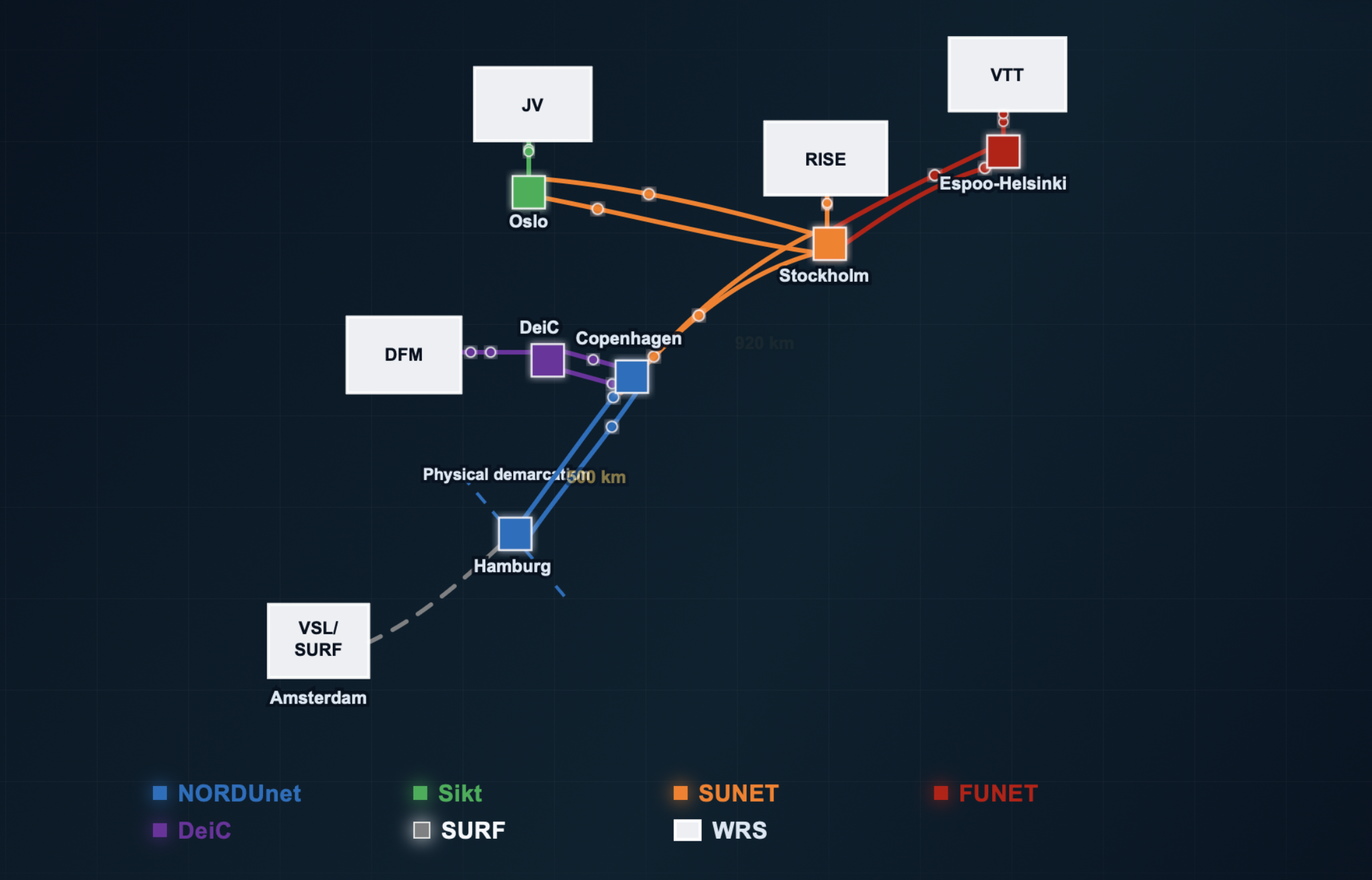
As of June 2026, the pilot has established a White Rabbit-based network time infrastructure connecting the NRENs of Denmark, Sweden, Norway, and Finland, as well as the NMI’s of the four countries, using a combination of unidirectional and bidirectional optical fibre connections (see map) of more than 2600 km total length. This allows testing of technologies and services. Furthermore, the infrastructure is being extended to connect with the NREN and GÉANT time infrastructures in North-West Europe.
Using this infrastructure, the NMI’s will test several use cases throughout the remainder of the year, hopefully leading to a better understanding of the technology, providing input for the partners to further evolve the infrastructure in the coming years.
At the TNC conference in Helsinki 8-12 June, NORDUnet will showcase the White Rabbit pilot at our booth. We are excited to collaborate with our European and global peers on time distribution,
White Rabbit
The White Rabbit technology (named after a character in the novel “Alice in Wonderland”) was developed as part of the timing system for the Large Hadron Collider (LHC) at the European centre for nuclear physics CERN. White Rabbit is originally an Ethernet-based local area network technology that enables time transfer with deterministic, sub-nanosecond precision. The original purpose of the technology was to allow thousands of detectors inside the LHC to time-tag measurement data in experiments with high-precision while using the same network to transmit data. This allows the many measurements to be compared to identify measurement resulting from the same particle collisions.
White Rabbit has been adapted for use in wide-area networks (such as the networks of NRENs). To achieve the highest precision in such networks, White Rabbit relies on sending data in both directions through a single optical fibre. This is known as bi-directional transmission
.