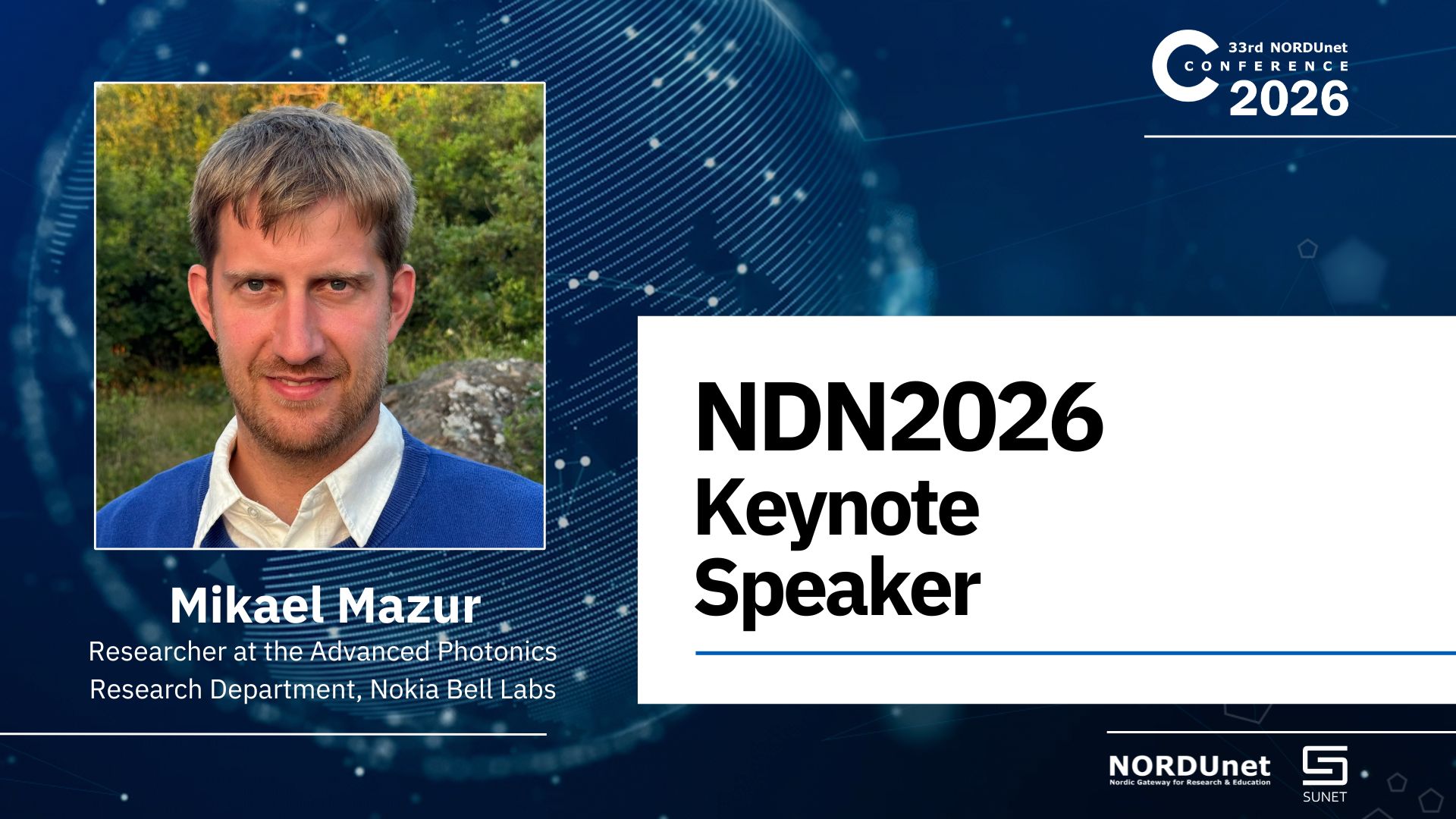
Sensing the Deep Ocean: Distributed Fiber Sensing Over Operational Trans-Oceanic Subsea Cables
While the purpose of optic fiber cables is transmitting data, it has transpired in recent years that they can also produce data. Subtle variations in the tension along the cable can provide early warning of potential cable breaks and contribute in many ways to monitoring the cable’s surroundings. This in turn can both help safeguard the cable itself and supply scientists with data that would otherwise be impossible or at best very expensive to obtain.
Mikael Mazur and his colleagues at Nokia Bell Labs have demonstrated sensing in more than 25 cable connections ranging from terrestrial links in urban environments to aerial fiber connections and inter-continental submarine cables up to 7,000 km. Notably, the trials have all been on existing cables:
“These cables were all designed before sensing became a hot topic.”
The sensing method applied is reminiscent of a one-dimensional radar. A so-called interrogator is installed at the cable end. The instrument emits an optical pulse into the fiber, and the backscattering taking place at different points through the fiber is measured. The resulting data can reveal seismic noise and other events in the vicinity of the cable.
Early warning of potential cable breaks
A breakthrough came in 2023, when Mikael Mazur approached Sunet, the research and education network (NREN) of his home country Sweden. Sunet allowed the industry research group to perform a trial over a 524 km aerial cable between Gothenburg and Karlstad.
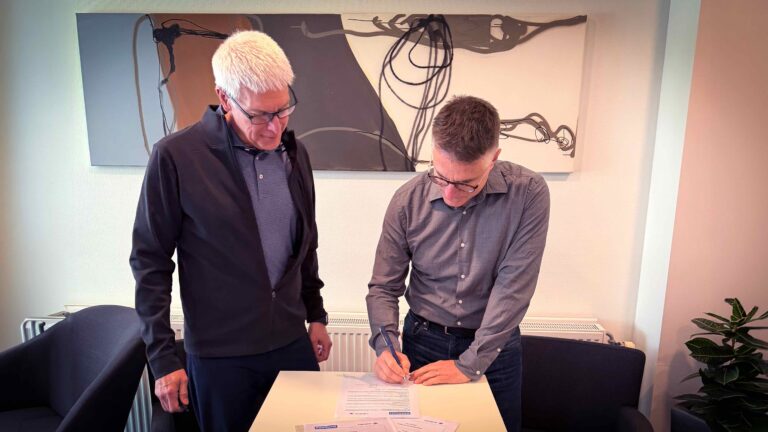
In a joint scientific paper, Sunet, Chalmers University of Technology, and Mikael Mazur’s group proved sensing technology able to spot precursors to cable breaks. Thereby, cable sections can be renewed proactively, avoiding the trouble and costly repair work associated with sudden breaks.
“The collaboration showed me a new angle on the value of research networks. Realistically, we would never have been allowed to do a trial like this at a cable operated by an industry client. Sunet saw the potential in sensing, and they gave us the first chance to obtain real hands-on technology use cases,” says Mikael Mazur.
Only real-world trials from now on
Besides providing the evidence for the method in relation to cable breaks, the trial in Sweden was an eye-opener for Mikael Mazur:
“It became apparent to me, just how much more complex and challenging the conditions for an operator like Sunet is relative to controlled conditions in the lab or a submarine cable which generally lives a quiet life at the ocean floor. I remember thinking that it was amazing that the technique still worked – but it did!”
As a direct result of this experience, Mikael Mazur and his colleagues no longer do lab trials:
“We still do some experiments of technical nature in the lab, but when it comes to demonstrating the sensing itself, we have decided to do real-world trials only from now on. We acknowledge that real-world conditions are complex to a degree that makes the results you can obtain under lab experiments of little value. Also, the technology has reached a state where you may just as well put it to use.”
Easy-going Scandinavians
Using interrogators is not the only sensing method in play. Another idea is to equip cables with sensors. This is the purpose of a major United Nations initiative.
“Point sensors are very attractive in monitoring environmental factors where the signals are much weaker than those from cable break precursors. Maybe unusual for an engineer, I am not so interested in promoting a specific technology. To me the mission is what matters. We simply must monitor climate and environmental conditions more closely, not least in the Arctic and Antarctic regions.”
Since the Gothenburg-Karlstad trial in 2023, Sunet has done more sensing projects while also NORDUnet, Sikt (Norway), SURF (The Netherlands) and other NRENs are active.
“I believe the project with Sunet was the first on a research network, and I think it did move the field forward. Since I was a graduate student there (at Chalmers, ed.) it was fun for me personally to do the trial in Sweden. Also, the Scandinavian mentality is quite easy-going, which I like. In all, the collaboration proved to be a great experience, and I am glad that I now have an opportunity to thank the Sunet team at the NORDUnet conference.”
Mikael Mazur is a researcher at the Advanced Photonics Research Department, Nokia Bell Labs, New Jersey, USA.