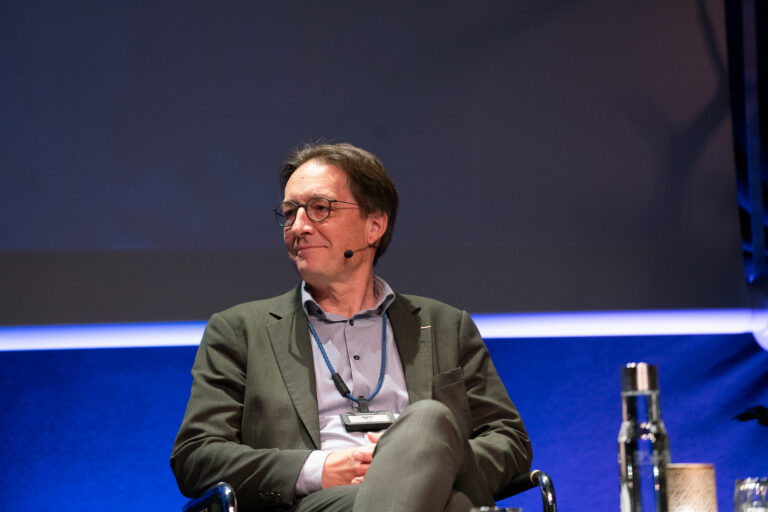

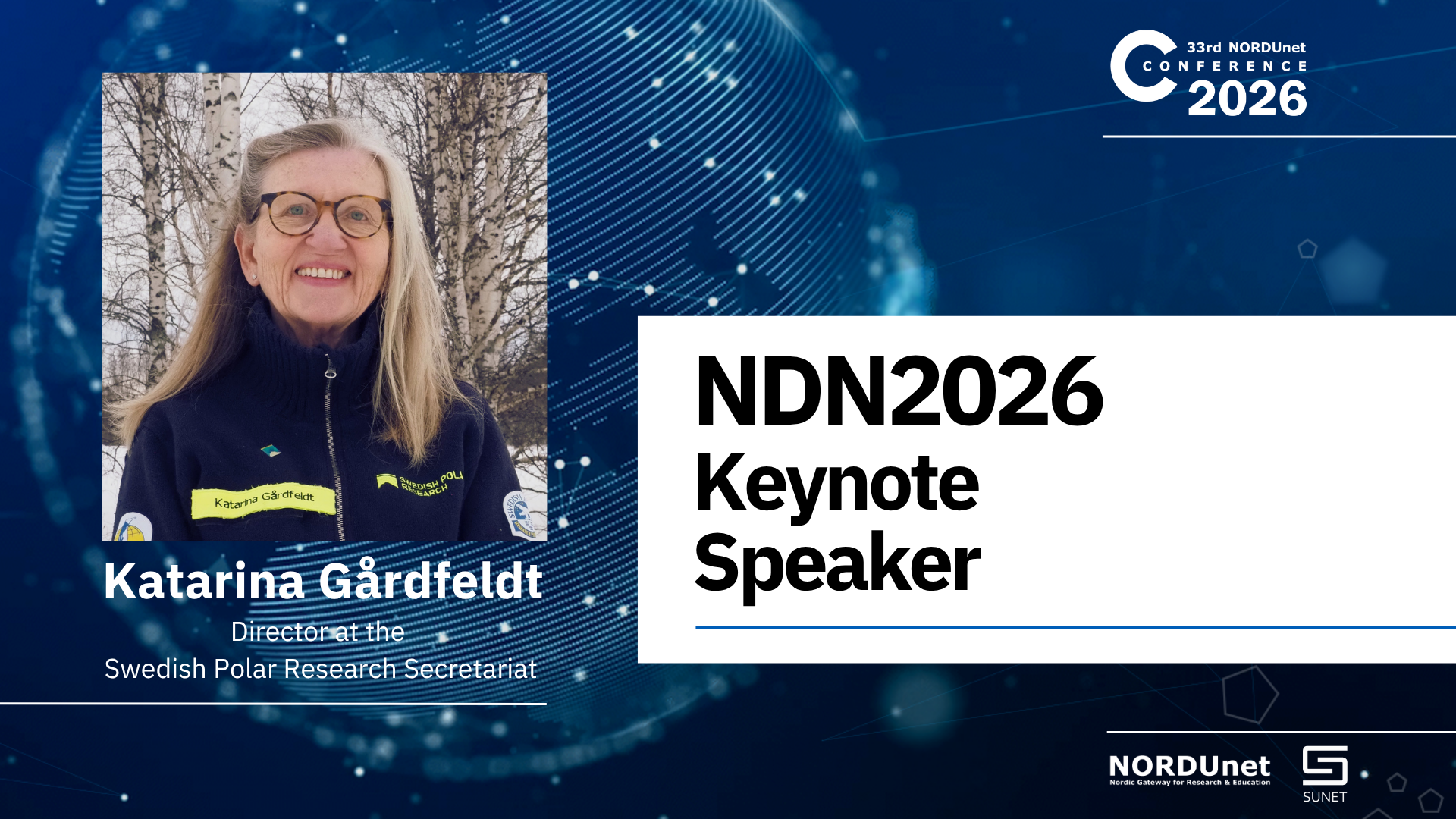
Improved cable laying techniques that combine advanced ice management and seafloor surveying have brought the vision of Arctic submarine connections within reach. This message from Katarina Gårdfeldt, Director at the Swedish Polar Research Secretariat, will surely resonate well with NDN2026 participants. NORDUnet and the National Research and Education Networks (NRENs) of the Nordic Countries are strongly involved in the Polar Connect project aiming to link Europe to Asia and North America via the Arctic Ocean.
“Recent surveying campaigns and progress in cable laying operations in ice covered environments have removed many of the uncertainties around the project. We can say today that realization of Polar Connect and similar projects will “only” be a question about money,” says Katarina Gårdfeldt.
In 2024, a Swedish Polar Research Secretariat study commissioned by NORDUnet looked at three alternative routes for Polar Connect, all three in the central Arctic Ocean close to the North Pole. The study pointed to a route through the Western part of the Arctic Ocean but close to the North Pole as both the shortest of the three and the one with the least challenging ice conditions.
Pioneering seafloor surveys
Swedish polar researchers are world leading in mapping the Arctic seafloor. In 2007, they introduced multibeam hydrographic surveying to the region. The instrument emits acoustic waves in a fan shape. Based on the time it takes for the sound waves to reflect off the seafloor and return to the receiver, water depths can be calculated.
One of the first surveys was commissioned by Denmark as part of a United Nations case around the extent of the continental shelf surrounding Greenland. More surveys for Denmark followed, and in 2016 a similar collaboration with Canada began, involving campaigns in 2025, 2026, and 2027.
“The extent of continental shelves is important in relation to international regulation of national sea boundaries etc. Still, our motivation as scientists is much broader. Many questions regarding how Arctic geology has developed remain unanswered. The surveys have allowed us to create a library on the development of the region. I would even say that we are shedding light on the history of our planet.”
Sidestepping underwater volcanoes
The Arctic seafloor library is obviously highly relevant in relation to Polar Connect.
“It would be extremely risky to deploy a submarine cable without detailed knowledge of the profile and composition of the seafloor. The cable specifications should be adjusted according to the exact route. Furthermore, the route must avoid hazards like underwater volcanoes, steep underwater mountainsides etc. So, once a tentative route is chosen a very detailed survey must be done,” explains Katarina Gårdfeldt.
The story does not end here, she notes:
“Having the methodology in place is not enough. Right now, the bottleneck is the availability of powerful icebreakers needed for the ice management while laying the cable.“
Only the top Swedish icebreaker Oden, used by the Swedish researchers in several surveying and scientific campaigns over the years, is of the standard required to be part of the ice management fleet.
“Even Oden is not strong enough be the vessel fronting the ice as the first vessel along the cable laying route. We will therefore need to build a new even stronger vessel,” Katarina Gårdfeldt notes.
Geopolitical developments drive interest
Discussions with the Swedish government on building a new vessel, the Swedish Heavy Polar Research Vessel, are ongoing.
“We imagine a flexible vessel that besides the truly scientific missions can serve several other purposes such as ice management in relation to laying and repairing cables. Further, we are looking at concepts which involve public-private partnerships contributing to financing the project.”
Here, Katarina Gårdfeldt notes a new trend:
“A few years ago, the general attitude from shipowners and other private stakeholders seemed to be that cable-laying in the Arctic region was just too risky. This perception is changing. Partly because of improvements in cable laying techniques involving capable icebreakers for ice management and surveying, but also due to the geopolitical situation. It has become clear how much the world currently depends on several connections in conflict areas with the Suez Canal as a clear example. This underscores the need for alternative routes for instance from Europe to Japan, South Korea and other Asian countries. On top of that, an Arctic route will be by far the shortest between Europe and Asia.”
Katarina Gårdfeldt is Director at the Swedish Polar Research Secretariat. She was main author on the secretariat’s report “Cable-laying project from Svalbard to the Bering strait through the Arctic Ocean” commissioned by NORDUnet, 2024.